Chapter 1 · A New Lamp Comes Home
Meet a device without mixing up all its names
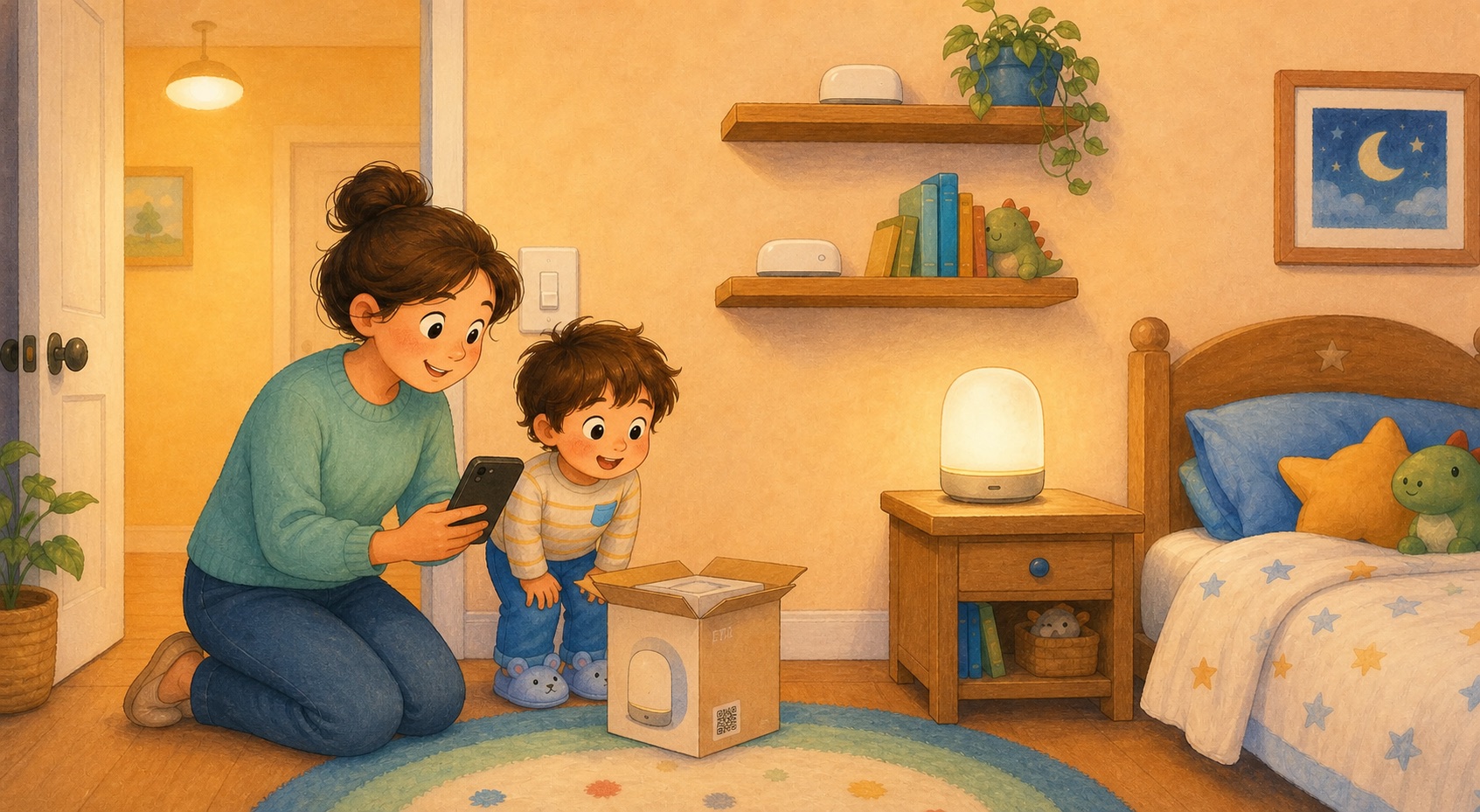
Page 1 · A new friend
Mum brings home a new lamp. The child says, “I want it beside my bed for picture-book time.” Its job is clear: it is the bedside reading lamp, not the boss of every light.
First say where it belongs and what help it should provide.
Behind the scenes: A household defines the long-lived functional role before treating a product name as identity.
Page 2 · Mum opens the door
Mum scans the little square on the box. The lamp and the home check each other. Only after Mum agrees may the device join the family home.
A responsible grown-up admits a new device.
Behind the scenes: Matter commissioning establishes a secure relationship with the home fabric.
Page 3 · What can it really do?
The lamp tells the Home Keeper, “I can turn on, turn off, brighten, and dim.” Those abilities are recorded. Looking like a clock does not make it able to tell time.
Record only abilities the device actually exposes.
Behind the scenes: Matter capabilities become Home Assistant Devices and Entities.
Page 4 · Many kinds of names
The box has a product name, the controller has a device identifier, and the child says “bedside lamp.” The Story Box links them without pretending they are the same kind of name.
Names can be connected without being collapsed.
Behind the scenes: Product, Node/Endpoint, Entity, asset, and functional role remain distinct identifiers.
Page 5 · A new lamp can take over
One day the lamp is replaced. The old device identifier retires, but the bedside-reading job remains. The new lamp takes the job without pretending to be the old lamp.
Devices change; a household role can continue.
Behind the scenes: A time-bounded identity binding preserves continuity across replacements.
Page 6 · The first light
Mum asks the new lamp to turn on. It responds, and the Little Eyes see the bedside really become brighter. Only then does everyone welcome the new bedside reading lamp.
A command reply is not enough; check the physical world.
Behind the scenes: HA/Matter control is followed by a physical Observation.
Chapter 2 · Little Eyes Walk Through the Home
An observation is a clue, not a license to guess
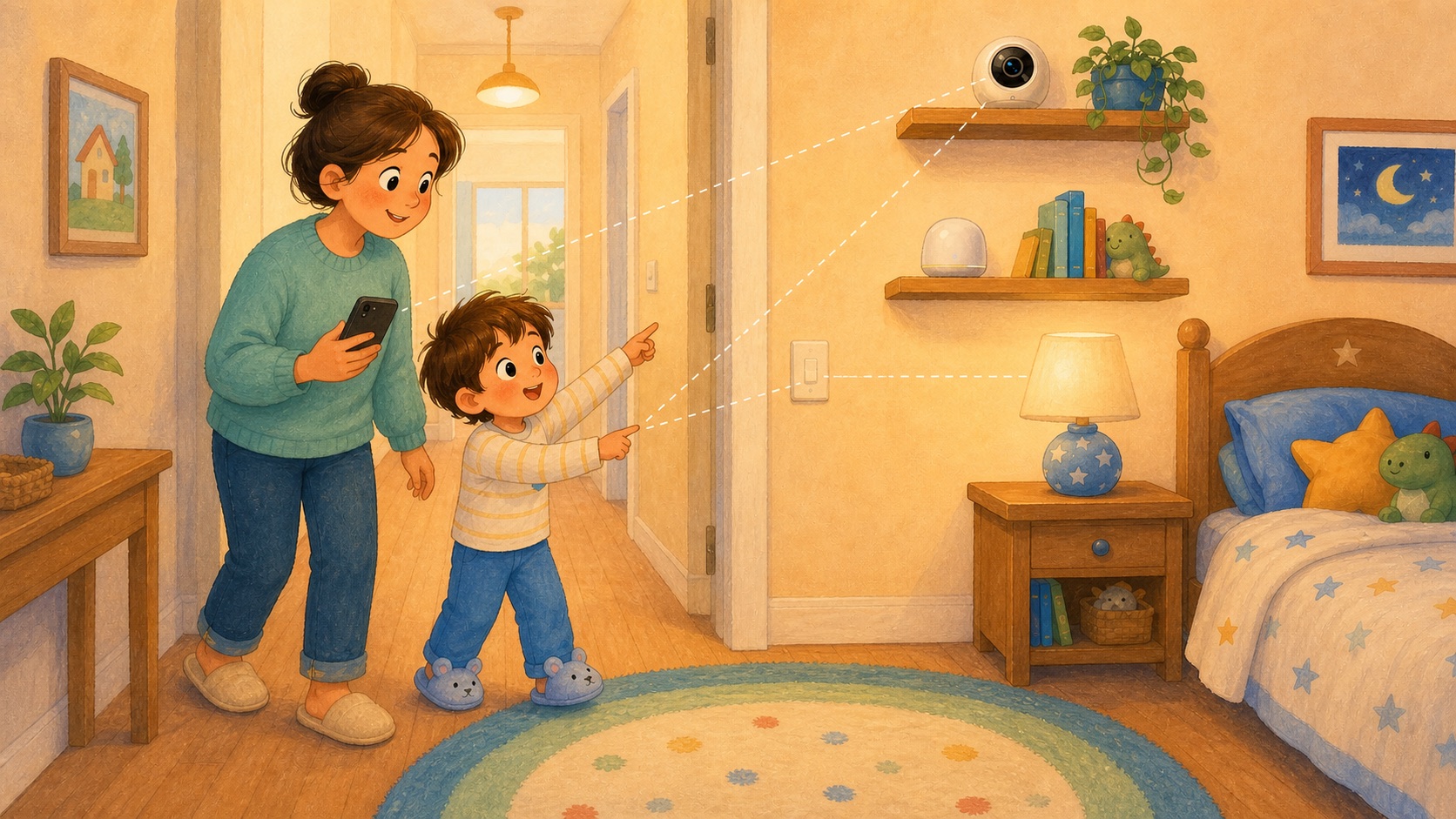
Page 1 · Say what we are looking for
The child says, “Please remember where my bed and lamp are, and look at this switch.” The Little Eyes receive only that task, not permission to take every corner of the home away.
State the purpose before deciding what to observe.
Behind the scenes: Bind observation to requester, purpose, scope, and time.
Page 2 · Look one step at a time
Mum carries the camera from the hall into the bedroom. The child points, the Little Eyes observe, and Mum may stop the walk at any time.
Observation has a companion and a stop button.
Behind the scenes: SOSA/SSN describes the sensor, procedure, feature, property, and time.
Page 3 · Keep the source
The Story Box records more than “there is a lamp.” It asks who saw it, when, from which direction, and whether a cupboard blocked the view.
Where a statement came from matters.
Behind the scenes: PROV-O records the model activity and inputs; C2PA can describe media history, not truth.
Page 4 · Seeing does not reveal purpose
The Little Eyes see a switch by the door and a lamp by the bed. They can report positions, but they cannot claim the switch controls the lamp without another test.
Location is a clue, not proof of control.
Behind the scenes: A spatial Observation supports a candidate relationship, not an accepted Claim.
Page 5 · Two eyes can share one mistake
Two models looking at the same blurry picture may agree and still both be wrong. Saying it twice is not automatically independent evidence.
Repeated evidence is not always new evidence.
Behind the scenes: Independence depends on provenance and procedure, not output count.
Page 6 · How much do we know now?
The Home Keeper makes a small map: the bed, lamp, and switch have positions; what the switch controls is still a question mark. Dada suggests a safe test, with Mum’s permission.
Write down both knowledge and uncertainty.
Behind the scenes: NGSI-LD can project current context; a purpose-bound World View preserves uncertainty.
Chapter 3 · Which Switch Controls Which Lamp?
Ask, test, and observe the real result
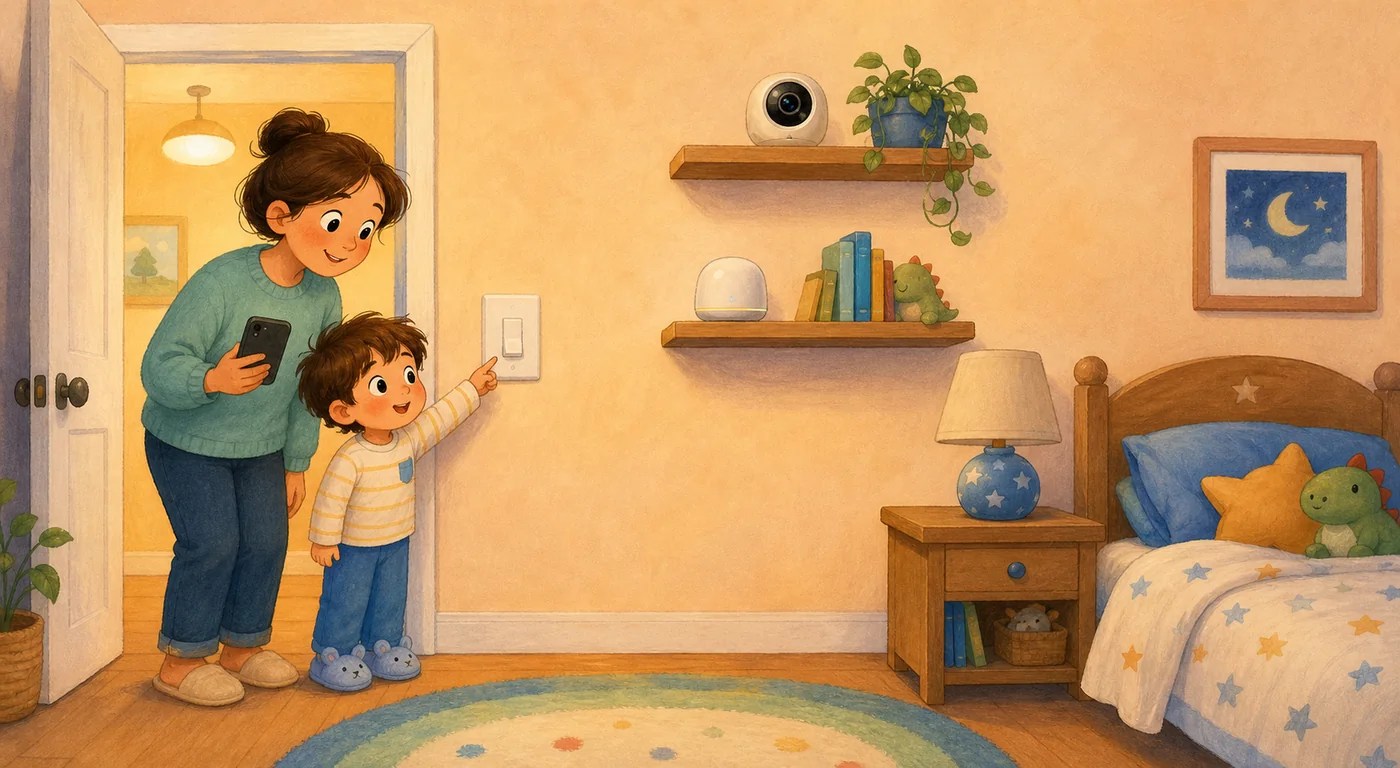
Page 1 · Say the wish
The child says, “Mum, I want to know whether this switch controls the bedside lamp.” Dada knows the goal because the child said it—not because a pointing finger was secretly interpreted.
If the wish is unclear, ask.
Behind the scenes: The Agent turns explicit intent into a test goal.
Page 2 · Near is only a clue
The switch and lamp are nearby, so they are worth checking. But the switch might control the ceiling light, the hall, or nothing at all.
Location helps form a question; it does not answer it.
Behind the scenes: Spatial proximity generates a candidate Claim, not a control relationship.
Page 3 · Dada proposes
Dada asks, “May we try this switch once and watch the bedside lamp?” Mum replies, “Yes. I’ll stay here, and we will try only once.”
Dada explains the test; Mum decides.
Behind the scenes: An exact Action Proposal revision receives a household decision.
Page 4 · What does the gatekeeper guard?
The Little Gatekeeper guards the entrance to controlling home devices, not the bedroom door. It checks that Mum approved this one switch, this one lamp, and this one test.
Mum grants permission; the Gatekeeper enforces its boundary.
Behind the scenes: ODRL can express policy; household authorization evaluates it.
Page 5 · The Home Keeper finds the device
A messenger carries the approved request home. The Home Keeper finds the bedside lamp and asks the Translator to speak to it.
The Keeper routes; the Translator speaks.
Behind the scenes: MCP carries the request; Home Assistant routes Entity and Action.
Page 6 · The Translator only translates
The Translator cannot decide to turn on a lamp. It turns the approved request into words the lamp understands. The lamp answers and begins to glow.
Decision stays with the household.
Behind the scenes: Matter sends the Cluster Command; acknowledgement is not final effect.
Page 7 · Observe before recording
The lamp saying “received” is not the end. The Little Eyes see the lamp really glow before the Story Box adds evidence. If blocked, they say, “I still don’t know.”
Physical observation adds evidence.
Behind the scenes: Actuation, Observation, and provenance remain separate; conflict is preserved.
Chapter 4 · Does Every Morning Mean a Rule?
A repeated pattern is not yet a household command

Page 1 · Dada notices repetition
On several workdays, the lamp, warmth, and hot water appear around seven. Dada lines up the observations and notices a pattern.
A repeated event can become a question.
Behind the scenes: Calendar, events, and observations support pattern detection.
Page 2 · Often does not mean wanted
Perhaps the week was unusually cold or the child was ill. Dada cannot secretly decide that the family wants this forever.
“Often happens” is not “please continue.”
Behind the scenes: Observed Pattern is not Intent, Routine, or Authorization.
Page 3 · Make the suggestion readable
Dada asks, “On workdays at seven, when someone is home and it is not a holiday, should we prepare gentle light and warmth?”
A suggestion states time, conditions, and actions.
Behind the scenes: Calendar exceptions and structured rules describe a candidate routine.
Page 4 · The family edits it
Mum asks for dimmer light. The child says, “Not on holidays.” Dada makes a new version and reads it back.
The family may accept, edit, or reject.
Behind the scenes: Authority activates one exact routine revision.
Page 5 · A rule is not a forever key
Even after Mum agrees, the Gatekeeper checks every morning: Is it a workday? Is someone home? Are the devices safe?
Every occurrence still has conditions.
Behind the scenes: ODRL constraints and current context are evaluated per occurrence.
Page 6 · Unknown means wait
If a toy blocks the camera, Dada cannot turn “I cannot see anyone” into “nobody is home.” The task waits.
Not visible is not absent.
Behind the scenes: Unavailable, withheld, absent, and negative observations remain distinct.
Chapter 5 · Monday Morning Relay
A rule reaches comfort through several distinct handoffs
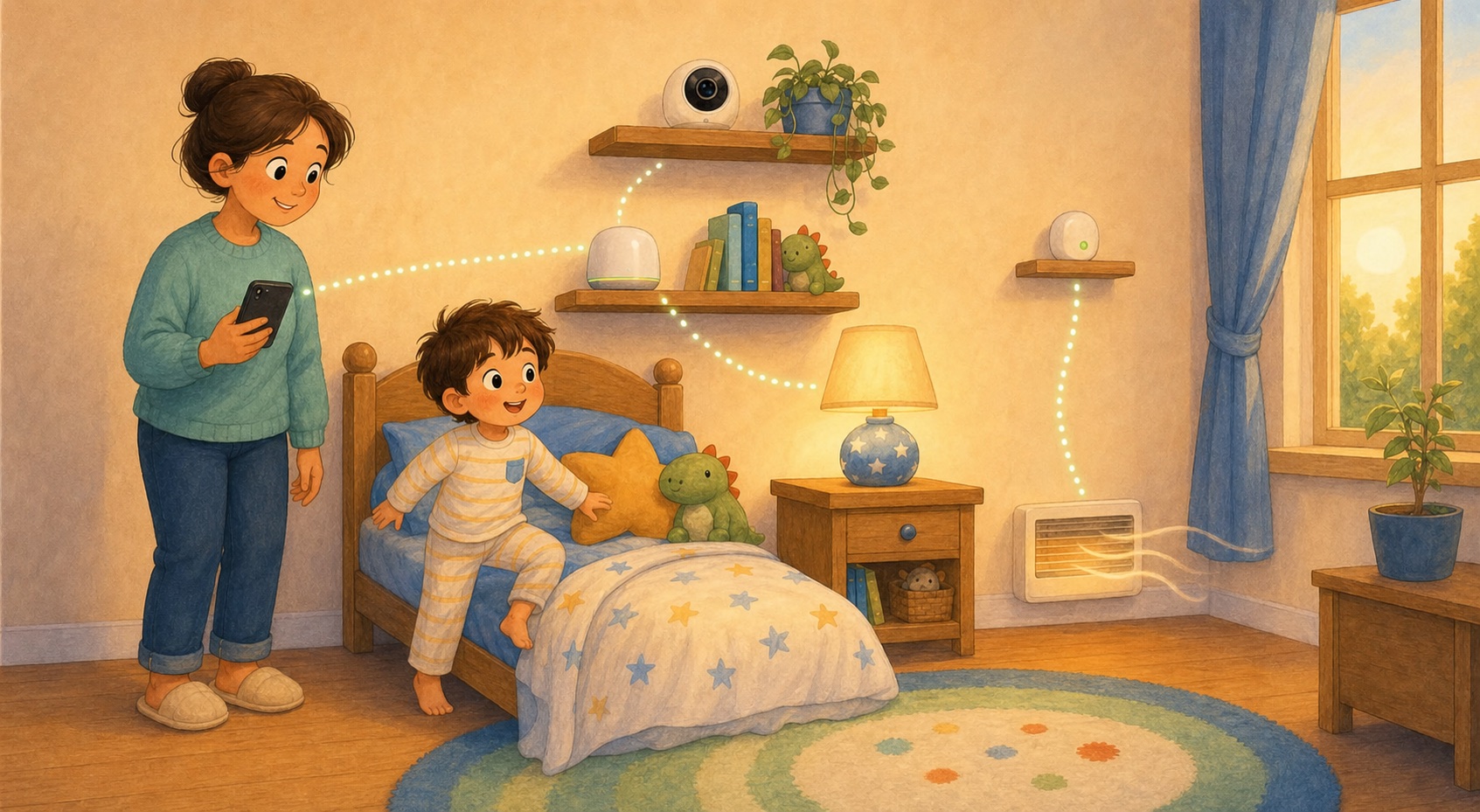
Page 1 · Take only what today needs
At seven on Monday, Dada asks for only the date, presence, relevant device states, and the current morning rule.
A task should see only what it needs.
Behind the scenes: A purpose-bound World View declares requester, time, epoch, coverage, and withheld inputs.
Page 2 · Conditions create a proposal
It is a workday, the family is home, and devices are healthy. Dada proposes gentle light and a little warmth.
Conditions may create a proposal, not an action.
Behind the scenes: Current context, Task materialization, and Proposal remain separate.
Page 3 · The Gatekeeper checks again
The Gatekeeper checks the exact rule version, other sleepers, rooms affected, and safety. It approves only these two small actions.
Every action has a bounded permission.
Behind the scenes: Household Authority evaluates the exact Proposal revision and impact.
Page 4 · Requests reach devices
The messenger, Home Keeper, and Translator carry the approved requests to the lamp and heater. Both devices answer, “Received.”
A device reply marks one relay handoff.
Behind the scenes: MCP → HA Action → Matter Command keeps transport and report stages distinct.
Page 5 · Did the room change?
The lamp reports brighter and the heater reports running. The Little Eyes see gentle light, while a temperature sensor measures warming air.
Observe the physical environment after device reports.
Behind the scenes: SOSA/SSN and PROV-O record real effects and their sources.
Page 6 · Comfort is the finish line
The child says the room is warm and the light does not hurt. Only then does the Story Box record execution, effect, goal satisfaction, and family acceptance separately.
Execution, effect, satisfaction, and acceptance are different.
Behind the scenes: Action Trace separates authorized, dispatched, reported, observed, satisfied, and accepted.
Chapter 6 · A New Dada, the Same Home Story
Household history belongs to the household
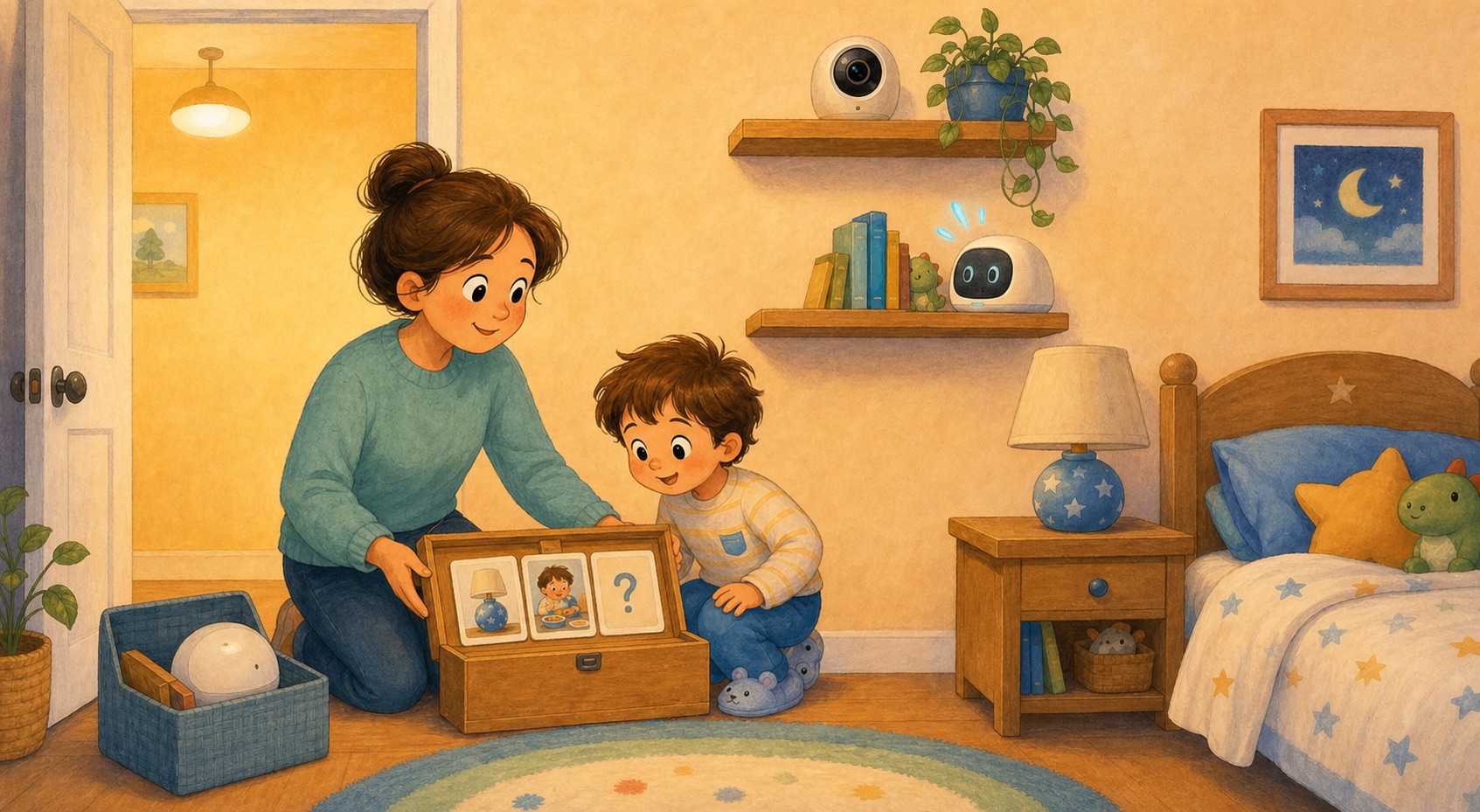
Page 1 · The old helper rests
Mum chooses a different AI helper. The old Dada keeps its secret thoughts and private chat drafts, but it cannot take household-owned devices, rules, or evidence.
Private Agent memory is not household history.
Behind the scenes: Hidden reasoning, session memory, and credentials are not transferred.
Page 2 · The Family Story Box stays
The box keeps the bedside-lamp role, the current routine, results, and open questions. Mum decides which cards the new helper may see.
The home need not explain everything again.
Behind the scenes: Solid-style resources stay household-controlled; read access is still purpose-bound.
Page 3 · The new helper introduces itself
The new Dada says who it is and what it wants to help with. The Gatekeeper checks it anew. Old keys do not fall into new hands.
A new Agent needs new admission and permission.
Behind the scenes: MCP discovery does not transfer the old Agent’s Lease or Authorization.
Page 4 · Prepare a small story package
To continue the morning task, the Story Box packs only the current rule, relevant devices, last valid observations, and one unresolved question.
A handoff is a task-sized package, not the whole warehouse.
Behind the scenes: A target-specific Checkpoint/RO-Crate preserves necessary artifacts and open conflicts.
Page 5 · Ask a specialist when needed
A heating specialist may return a report. Its task being complete does not mean the home is already warm or repaired.
A delivered artifact is not household success.
Behind the scenes: A2A task completion is distinct from Household Task satisfaction and acceptance.
Page 6 · Continue from family history
The new Dada says, “I know the bedside lamp and routine, but this question still needs checking.” New work keeps its new author.
Continuity lives in reconstructable household history.
Behind the scenes: PROV-O preserves attribution; the new Agent continues from a new View and new authority.