Devices are connected · the home is not yet understood
Why does a smarter home still fail to understand you?
At 7:00 a.m., a child says, “Turn on the lamp by the bed—but not too bright.” The system may send a successful command and still not know which physical lamp the child means, whether today’s routine applies, or whether the room actually became comfortable.
Devices are connected. The household is still not truly understood.
Public architecture hypothesis · v0.1 · 2026-07-31
This is an early public discussion, not a finished standard or product.
Context is not permission. A command is not a verified result.
SeeRememberAskVerify
The next Agent receives a fresh, purpose-bound view of the home—not the previous Agent’s private memory or powers.
The problem begins in an ordinary morning
Connected does not mean understood
Today’s systems can report states and execute commands. They rarely know what those states mean inside a particular home.
07:00
The command can succeed while the request still fails
The system may know that several lights are online. It may know their device names, current states, and which API can switch them.
But the child did not ask for an API call. The child meant a particular lamp, a gentle physical effect, and a result appropriate for this morning—not every morning in the abstract.
The devices have been connected. The household has not yet been understood.
01
Device names are not household meaning
“light.bedroom_02” identifies a record in a system. It does not explain that this is the lamp a child calls “the one by my pillow,” what it illuminates, or when it is safe to use.
02
A sensor signal is not a complete event
Motion, sound, or a camera frame is an observation. It does not by itself identify who is there, what they intend, or whether the family wants the system to respond.
03
A stored rule does not understand today
A weekday schedule may be useful evidence. It cannot know on its own that today is a holiday, someone is ill, or the family has changed its plan.
04
Command success is not a changed room
A device may acknowledge “on” while the lamp is unplugged, blocked, or too dim. What matters is the physical effect, observed after the command.
05
Every platform change makes the home teach itself again
Names, room assignments, routines, and corrections are often trapped in one app or Agent. Replace it, and the household’s accumulated understanding disappears with it.
06
Knowing something does not grant the right to use it
A system may know who is home, where a camera points, or when a child sleeps. That context must not silently become permission to observe, infer, or act.
07
The home changes while its model stays at installation day
Furniture moves, switches are rewired, devices are replaced, and family routines evolve. A useful home model must keep evidence, uncertainty, and corrections alive over time.
Change the AI. The home should not have to start over.
What is missing is not another remote control
Matter, Home Assistant, KNX, sensors, cameras, and vision models can already connect devices and report what they observe. Large language models can explain, plan, and converse.
The missing bridge is a household-controlled way to turn those signals into bounded, correctable understanding that can survive a change of device, platform, or Agent.
How can an Agent keep learning one particular home—without treating guesses as facts, context as permission, or command success as a real-world result?
Give the Agent enough of the home—not the whole home
The Harness compiles the smallest context for the task. HWM keeps the evidence and household rules. The Agent explains, plans, and proposes. Reality gets the last word.
HWM is an open proposal for a household-controlled, portable, reconstructable history of claims, evidence, and authority.
01
See
Vision, sensors, Matter, and Home Assistant report observations and device state.
Existing device paths
02
Remember
HWM keeps attributable claims, evidence, bindings, corrections, and household Authority.
Household-controlled history
03
Shape the context
The Harness starts with a purpose-bound current view—often NGSI-LD—and adds bounded HWM history only when needed.
Task-to-context compiler
04
Help, then check
The Agent explains or proposes. The family authorizes an exact action, and fresh observation verifies the physical effect.
Governed action loop
Two boundaries stay visibleContext is not permission. A command is not a verified result.
Knowing is not permission
A World View can help an Agent reason. Only household Authority can approve the exact action.
A reply is not reality
A device can report success while the room stays dark. New evidence must verify the intended effect.
Existing protocols keep their jobs
Matter / HA / KNX
Connect and control devices
NGSI-LD
Project the current semantic situation
HWM
Preserve reconstructable evidence, history, and governance
API / CLI / Skills / MCP / A2A
Replaceable doors for different Agents and tools
A discussion framework, not a frozen architecture
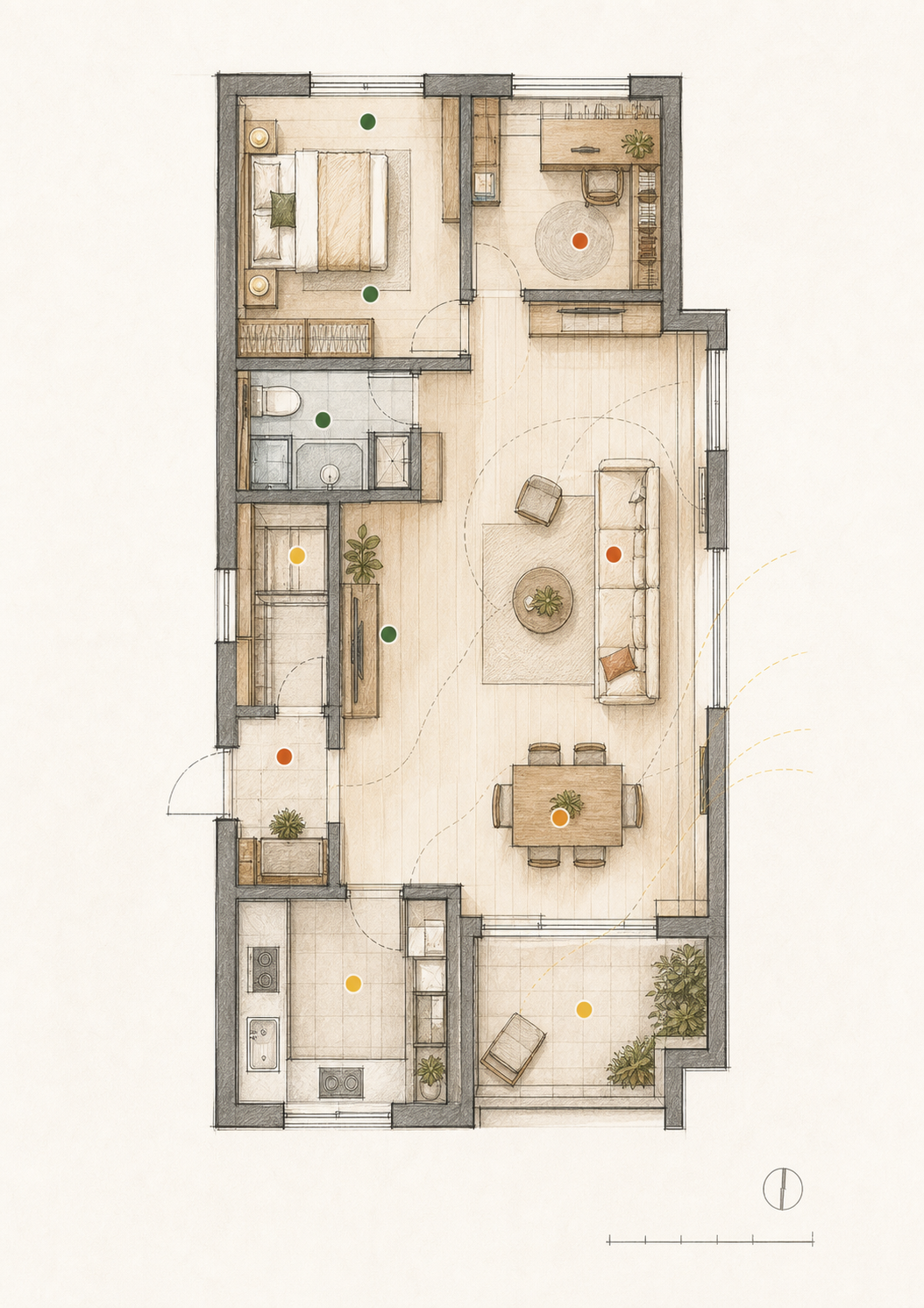
What might a home world contain?
The proposal starts with six connected ways of knowing. Each can remain incomplete, uncertain, and open to correction.
01
Space
Rooms, openings, furniture, functional zones, distance, direction, and obstruction.
02
Physical effects
Where a device is installed and how light, heat, air, sound, energy, or signal moves.
03
People & permission
Family members, pets, visitors, roles, states, preferences, and action boundaries.
04
Time & rhythm
Moments, life stages, habits, exceptions, and events that may be about to happen.
05
Evidence
Observation, identification, fact, inference, and prediction kept visibly distinct.
06
Lifecycle
Design intent, construction reality, commissioning, operation, change, and repair.
For children and grown-ups to read together
Meet Dada and the home that remembers
Six illustrated chapters turn identity, observation, permission, device control, real-world verification, and Agent handoff into one clear family story.
A nearby switch is a clue, not proof. The family asks, authorizes, tests, and observes.
A responsible Agent knows what it does not know
From observation to responsible action
Illustrative sequence · every layer remains open to correction
01
Observation
A hallway sensor reports movement.
02
Identification / fact
The source might be a family member, visitor, or pet.
03
Inference
Someone may be passing through rather than staying.
04
Prediction
Low, non-glare light may be useful next.
05
Permission
Is proactive lighting allowed here, now, and for this person?
06
Action & validation
Act at low cost, verify the effect, explain it, and allow correction.
Open by ownership, not only by source code
A home should not have to explain itself again whenever technology changes
What we hold
The home model belongs to the household.
A home should outlast devices, platforms, and AI models.
Facts, inferences, and predictions must remain distinguishable.
Proactive service requires permission, explanation, and reversal.
Privacy is part of the structure, not a later setting.
What this is not
—Not a new device communication protocol.
—Not a replacement for Matter, KNX, or Home Assistant.
—Not a single-company home cloud or a wrapper for OpenClaw.
—Not a mandate for how every household should live.
—Not permission for an Agent to act without authority or accountability.
The proposal should map to and collaborate with Matter, KNX, Home Assistant, BIM, Brick, W3C WoT, and other existing work—not replace it.
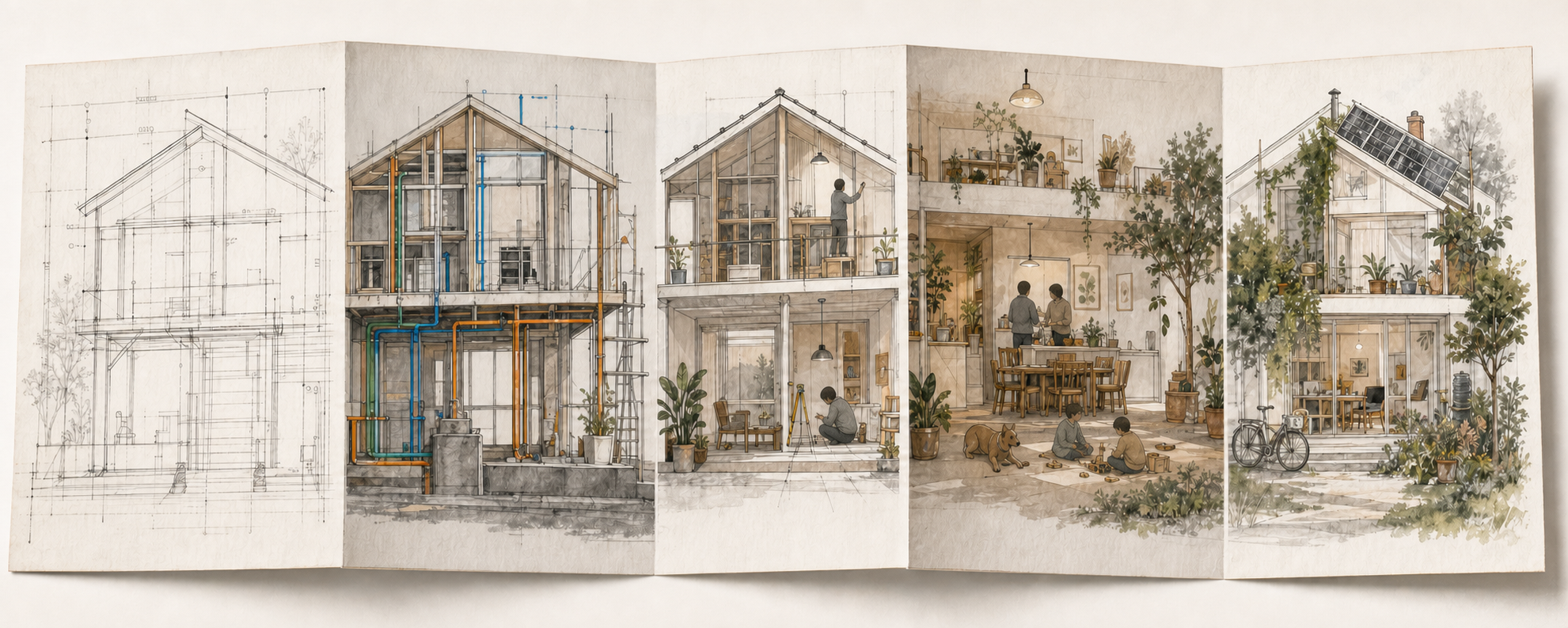
One home, one continuous record
From drawing to construction, commissioning, life, and change
A home begins forming before anyone moves in. Design assumptions, site changes, measurements, and later corrections should contribute to the same household-owned understanding.
01 · DrawingIntent and constraints02 · ConstructionWhat was actually built03 · CommissioningMeasure and calibrate04 · LivingNeeds, routines, and exceptions05 · ChangeReplace, repair, and learn
You do not need to write code
Help define what a home-aware Agent must know—and what it should never assume
Contribute a household story, professional constraint, mapping to existing standards, or a reason this proposal is wrong. Disagreement is useful evidence.